Wait! Don’t Go Yet! 👋
Compare Before You Book.
Explore offers from multiple verified Hajj operators and make an informed decision with transparent comparisons.
Compare Before You Book.
Explore offers from multiple verified Hajj operators and make an informed decision with transparent comparisons.
بسم الله الرحمن الرحيم
A step-by-step walkthrough of every ritual, day by day — so you can arrive prepared, focused, and spiritually ready for the greatest journey of your life.
"Whoever performs Hajj for the sake of Allah and does not utter any obscene speech or do any evil deed, will go back as sinless as a newborn baby."— Sahih al-Bukhari · Narrated by Abu Huraira (RA)
Hajj begins long before you board the plane. True readiness is spiritual, physical, and practical — and each dimension matters.
Hajj begins in the heart. Seek sincere repentance (Tawbah), clear any outstanding debts, ask forgiveness from those you have wronged, and make a firm intention to return changed.
Hajj involves extraordinary physical exertion — walking up to 15km daily in intense heat. Begin training your body months ahead.
Pack light, but pack smart. Every item should serve a purpose in the conditions you'll face.
Administrative readiness prevents unnecessary stress during the pilgrimage itself. Organize everything well in advance.
Understand the geography before you arrive. Every pilgrim will travel between these holy sites across the five days of Hajj.
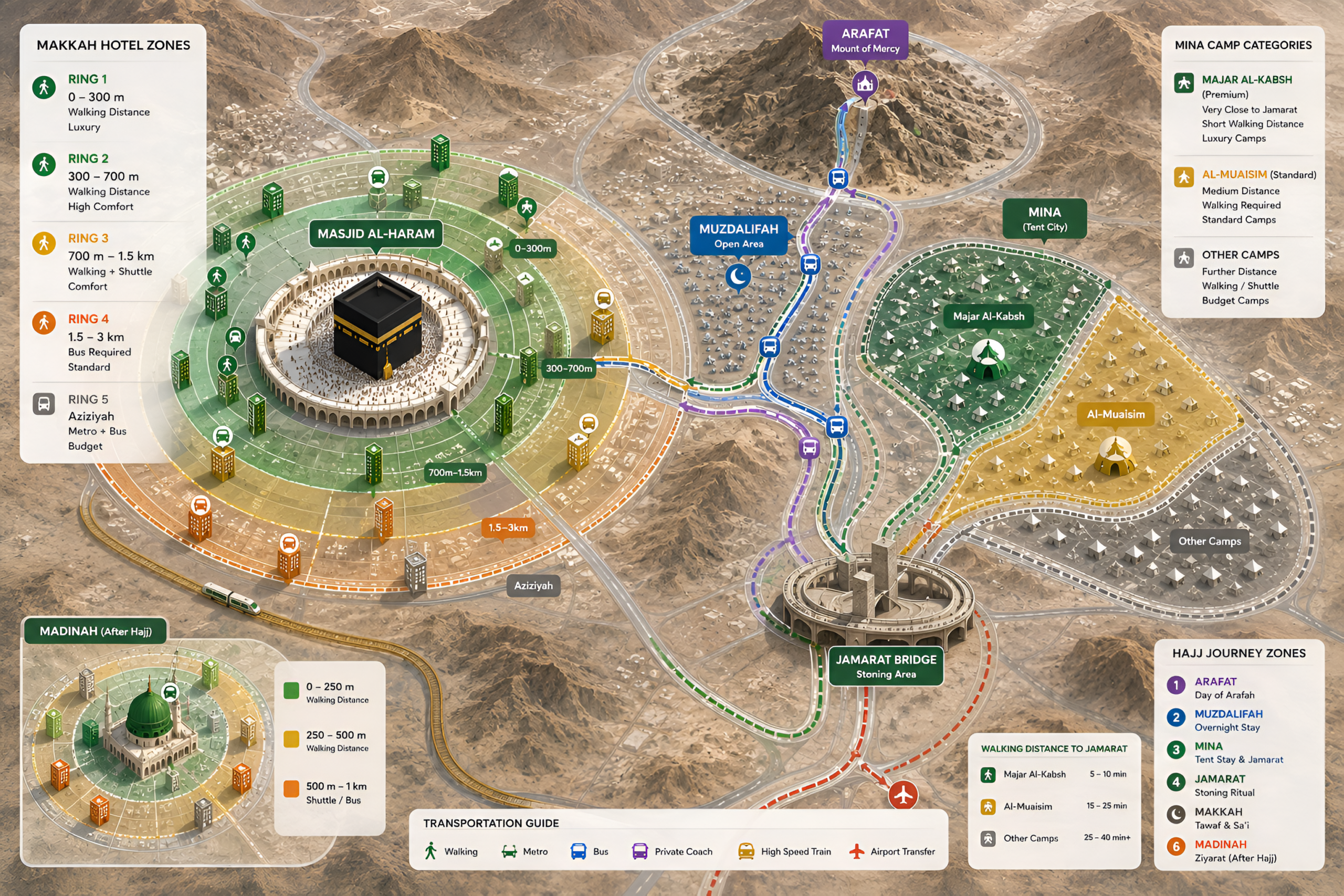
Follow each ritual in sequence. Missing or delaying an obligation can require a Fidyah (expiation). Mubarakhajj guides are with you at every step.
Before crossing the Miqat boundary — the geographical threshold every pilgrim must not pass without entering Ihram — you must perform Ghusl (full ritual bath), wear your Ihram garments, and declare your Niyyah. This is the first and one of the most spiritually significant acts of Hajj.
For men, Ihram consists of two white, unstitched sheets: one wrapped around the waist (Izar) and one over the shoulder (Rida). There are no seams, no zips — a radical equality with every other pilgrim before Allah. For women, it is any modest, loose-fitting clothing covering the full body except the face and hands.
Once in Ihram, begin reciting the Talbiyah continuously:
"Labbayk Allahumma Labbayk. Labbayk laa shareeka laka Labbayk. Innal-hamda wan-ni'mata laka wal-mulk. Laa shareeka lak."
"Here I am, O Allah, here I am. Here I am, You have no partner, here I am. Verily all praise, grace and sovereignty belong to You. You have no partner."
While in Ihram, you must avoid:

On the 8th of Dhul-Hijjah — called Yawm at-Tarwiyah (the Day of Quenching), named after pilgrims who historically carried water here — you travel from Makkah to the sprawling valley of Mina, just 5km from the Masjid al-Haram. The valley transforms into a city of over 100,000 air-conditioned tents, housing pilgrims from every nation on earth.
Spend this day and night in ibadah (worship), rest, and mental preparation for the immense spiritual experience ahead. This is the day the Prophet Ibrahim (AS) began his journey, and following his footsteps is itself an act of devotion.
The crowds in Mina are immense. Keep your Mubarakhajj group together, note the tent number and your group leader's number. Never leave without telling someone where you're going.
The Prophet ﷺ said: "Hajj is Arafat." Everything else in the pilgrimage supports this singular moment. If you miss the Wuquf at Arafat, your Hajj is not valid. After Fajr prayer in Mina, pilgrims move to the vast plains of Arafat — the place where Adam and Hawwa (AS) reunited after being descended from paradise, and where the Prophet ﷺ delivered his farewell sermon to 124,000 companions.
You must be within the boundaries of Arafat from the time Zuhr begins until after sunset. Zuhr and Asr prayers are combined and shortened, performed at Zuhr time. The remaining hours until sunset are the Wuquf — the standing before Allah.
Prepare a written Dua list before you arrive at Arafat. In the emotion and chaos, it is easy to forget what you intended to ask for. Include names of family members who need healing, forgiveness, guidance. This is your window to the heavens — don't leave it mostly closed.
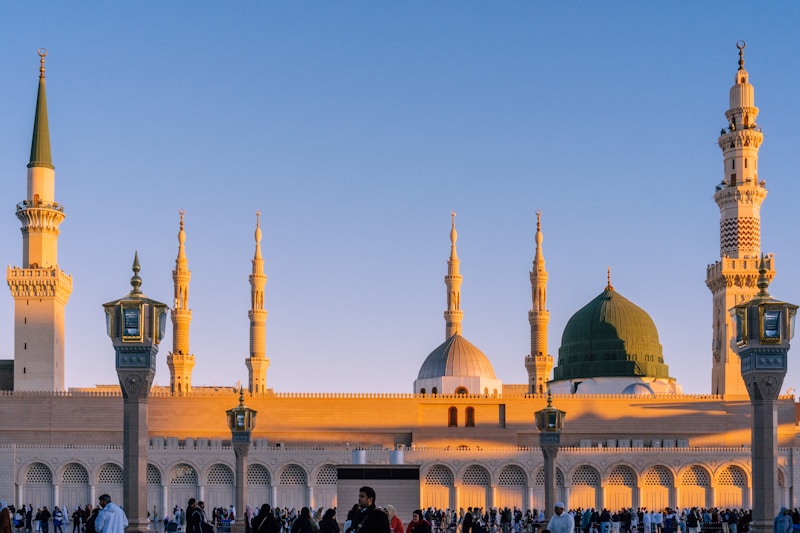
Immediately after sunset in Arafat, the entire multitude of pilgrims begins moving toward Muzdalifah — a valley between Arafat and Mina — in what becomes one of the largest human movements on earth. Do not pray Maghrib at Arafat; delay it until you reach Muzdalifah, where Maghrib and Isha are combined and shortened.
At Muzdalifah you sleep under the open sky, with no tent, no luxury — only the stars above and millions of fellow pilgrims around you. This profound equaliser strips away status and wealth, leaving only the servant before the Creator.
Do not collect pebbles from the toilets or obviously impure areas. Any clean gravel from the ground works. They do not need to be washed. Save counting them until you settle for the night — it's a calming task before sleep.
The 10th is the most physically demanding day. You will perform up to four major rituals, ideally in order, though Islam's scholars acknowledge the chaos of crowds and allow some flexibility. This is also Eid al-Adha — celebrated by Muslims worldwide as the day Ibrahim (AS) was ready to sacrifice his son, and Allah provided a ram in his place.
The crowds at Jamarat on this day are at their absolute peak. Mubarakhajj will advise on the safest times to go. Follow your group, do not rush, and remember that throwing 7 pebbles is a worship — not a race.
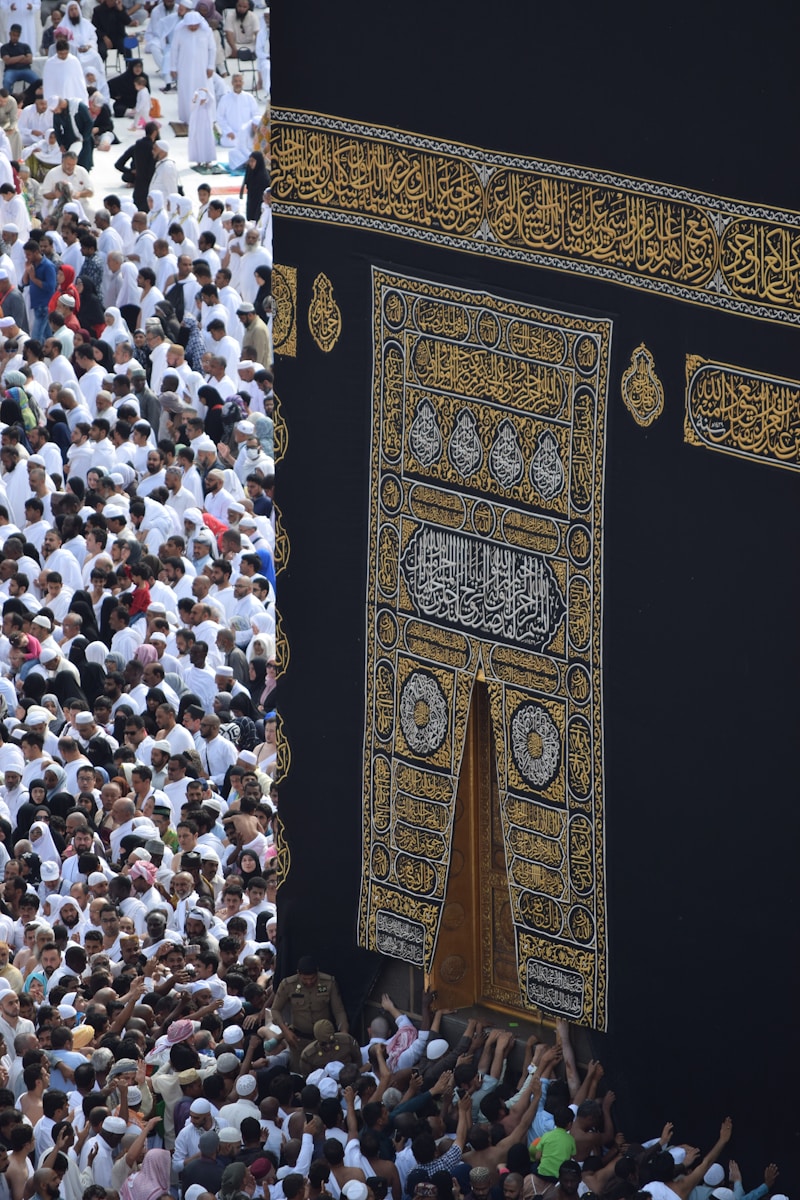

The Days of Tashreeq are named for the practice of drying and curing meat from the Qurbani in the sun. Pilgrims remain in Mina, engaged in remembrance of Allah, eating, resting, and completing the Rami.
Each day after Zuhr time, pilgrims must stone all three Jamarat in order: the small pillar (Jamarat as-Sughra), the medium pillar (Jamarat al-Wusta), then the large pillar (Jamarat al-Kubra), throwing 7 pebbles at each. This is done on both the 11th and 12th (and 13th if remaining). Do not rush or push — be patient and remember the spiritual meaning of each throw.
This is one of the most emotional moments of the entire journey. As you circle the Kaaba for the last time, many pilgrims weep openly, not knowing if they will ever return. Cherish every step. Ask Allah to bring you back again, and to accept your Hajj Mabrur.
These are among the most recited supplications throughout Hajj. Committing them to memory frees your mind to focus on their meaning, not their pronunciation.
This guide is a starting point — not a replacement for proper training. Mubarakhajj's certified scholars and experienced guides will be with you at every step, in every tent, and at every ritual.
© 2026 Mubarakhajj · This guide is for educational purposes. Consult your Muallim for personal rulings.